

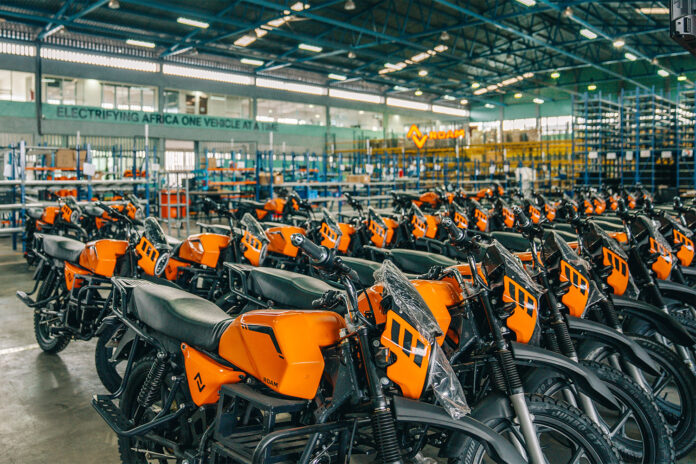
Kenya and Switzerland have approved a landmark carbon-finance initiative expected to support the local production and deployment of 226,000 electric motorcycles, accelerating the country’s transition towards cleaner transportation.
The authorisation was announced on November 19, 2026, during the 31st United Nations Climate Change Conference (COP31) in Antalya, Turkey, marking the first project approved under the two countries’ bilateral climate agreement.
Kenya’s Cabinet Secretary for Environment, Climate Change and Forestry, Dr Deborah Mlongo Barasa, and Swiss Federal Councillor Albert Rösti formally marked the development.
Known as E-Mobility Solutions in Kenya, the initiative is owned and operated by Roam Electric, with support from First Climate and Article Six Group.
The programme will replace conventional petrol-powered boda-bodas, widely used across Kenya for passenger transportation and deliveries, with locally manufactured electric motorcycles.
Under the arrangement, emissions reductions generated by the project will be converted into Internationally Transferred Mitigation Outcomes (ITMOs), which will be purchased by the Swiss KliK Foundation. Revenue from these carbon credits will provide financial support for the project’s expansion.
The funding will be channelled into four key areas: reducing motorcycle purchase prices for riders, supporting local assembly, expanding charging infrastructure and developing battery recycling systems.
The KliK Foundation purchases the credits to fulfil the legal obligation imposed on Swiss motor fuel importers under the Swiss CO₂ Act to offset part of the country’s transport emissions. It anticipates that approximately five million ITMOs will be transferred from its Kenyan portfolio by 2030.
The project will operate in addition to Kenya’s existing climate commitments under the Paris Agreement, known as its nationally determined contribution (NDC).
It also satisfies the eligibility requirements of Kenya’s carbon-market framework and Switzerland’s CO₂ legislation. Complete project documentation has been published by the Swiss Federal Office for the Environment (FOEN) in its register of overseas compensation projects.
The initiative addresses significant challenges facing Kenya’s transport sector, which accounts for the country’s largest share of energy-related emissions. The rapidly expanding population of conventional motorcycles without emission controls contributes substantially to the problem.
Although the Kenyan government has identified electric mobility as a national priority, adoption has remained limited because of high initial purchase costs and inadequate charging facilities.
The newly authorised programme is designed to address both constraints while establishing a framework for future carbon-financed activities under the Kenya-Switzerland agreement through 2030.
Its approval also provides a potential financing model for other manufacturers, fleet operators and investors interested in African electric two-wheeler markets, demonstrating how verified emissions reductions can generate revenue for clean transportation projects.
Roam Electric Chief Executive Officer and co-founder Filip Lövström described the development as the first agreement of its kind in East Africa to deploy carbon finance towards expanding electric motorcycle adoption.
He explained that the motorcycles are manufactured in Kenya to suit local riding conditions, with every kilometre travelled monitored to ensure that the project’s environmental benefits can be independently verified.
For motorcycle operators, the programme is expected to deliver more affordable purchase prices, predictable and reduced daily operating expenses, and improved income stability.
Kenya also anticipates employment opportunities across manufacturing, charging services, maintenance and fleet technology, alongside improved air quality in urban centres and surrounding communities.
Cabinet Secretary Barasa described the approval as “an important milestone in our partnership”. She said the development demonstrates how cooperation under Article 6.2 of the Paris Agreement can translate into practical climate action.
Similarly, Yannick Träris-Kahriman, Head of Technology at the KliK Foundation, said the first authorisation sends a strong message to participants in international carbon markets.
He noted that the development positions Kenya at the forefront of global Article 6.2 implementation, adding that the foundation expects further project authorisations to follow soon.
SOURCE:The Pack
Do you want to share your impact stories or pitch the coverage of your CSR event to us? E-mail: editor@impactwatch.net or *Phone +234-806-795-0250 (Whatsapp &Text)


