

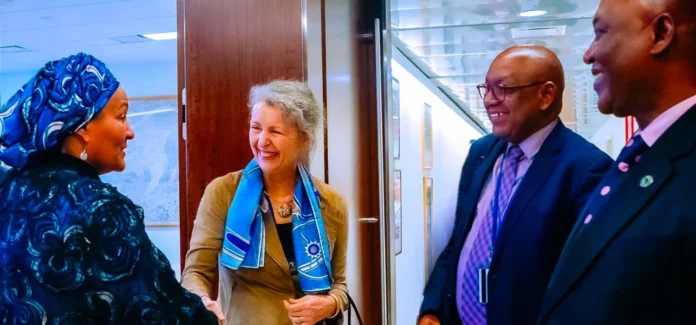
Led by Senior Vice President Marie-Laure Akin-Olugbade, representing Bank Group President Sidi Ould Tah, the delegation participated in high-level forums and bilateral meetings from 20 to 25 September. Discussions covered development finance, critical minerals, energy access, job creation, peacebuilding and resilience.
The engagements took place against a backdrop of tighter financing conditions, rising debt, climate shocks, humanitarian emergencies and growing pressure on African countries to create opportunities for their expanding young populations.
The Bank’s approach centred on three priorities: financing Africa’s transformation, building partnerships capable of delivering results at scale, and strengthening resilience before crises emerge.
These priorities align with the Bank’s Strategic Four Cardinal Points and the New African Financial Architecture for Development (NAFAD), which seeks to mobilise domestic savings, strengthen African financial institutions and reduce the continent’s annual development-financing gap.
“UNGA81 gave the Bank an important platform to bring Africa’s priorities into global discussions and, more importantly, to forge the partnerships needed to act on them. Our focus is on moving from dialogue to delivery—mobilising capital, building resilient institutions and creating opportunities that improve people’s lives across the continent,” Akin-Olugbade said.
At a high-level roundtable convened by UN Deputy Secretary-General Amina Mohammed on the future of sustainable development, Akin-Olugbade called for stronger multilateral cooperation to translate international commitments into tangible outcomes for Africa.
She advocated financing models that support nationally determined priorities, expand opportunities for young people and accelerate progress towards the Sustainable Development Goals.
She also identified guarantees, blended finance, strategic equity investments and stronger capital markets as mechanisms for directing investment towards infrastructure, trade, industrialisation and the green transition.
At a strategic meeting of G7 development ministers at UN headquarters, Akin-Olugbade highlighted the Bank’s investment in African Trade and Investment Development Insurance (ATIDI) as an example of strengthening an existing African institution rather than establishing a new mechanism.
The Bank’s $125 million equity investment increased its stake in ATIDI fivefold, making it the institution’s largest shareholder and strategic anchor. The investment is intended to strengthen the insurer’s capacity to support investment across Africa.
The Bank and its partners are also developing a Pan-African Guarantee Platform under NAFAD to coordinate guarantees, insurance and risk-sharing arrangements.
The initiative aims to help ATIDI achieve $2 billion in paid-in capital and $20 billion in annual guarantee capacity, potentially addressing half of Africa’s guarantee gap.
During the week, the delegation also engaged governments, regional organisations, UN agencies and businesses on development cooperation, regional integration and peace.
Meetings with the President of Comoros, the Intergovernmental Authority on Development and the African Union High Representative for Silencing the Guns focused on peacebuilding, regional integration and development.
Separate discussions with the UN Global Compact, UNICEF and UNHCR examined resource mobilisation, employment creation and challenges affecting fragile countries.
The delegation also signed two Letters of Intent with the Global Community Engagement and Resilience Fund (GCERF) and the United Nations Peacebuilding Support Office. The agreements are expected to deepen cooperation with the UN and advance the partnership-driven approach promoted by Ould Tah.
Peace, resilience and support for countries affected by fragility formed another central part of the Bank’s engagements.
Marking 10 years since the World Humanitarian Summit, Akin-Olugbade called for a shift away from repeated crisis responses towards prevention, stronger institutions and sustainable livelihoods.
She stressed the need for humanitarian, peacebuilding and development organisations to work more closely together, ensuring financing addresses the underlying causes of fragility and helps countries withstand future shocks.
The delegation also highlighted the Africa Disaster Risk Financing Programme, implemented with African Risk Capacity. The programme arranges sovereign insurance in advance, enabling governments to access funding quickly when disasters or other shocks occur.
Further cooperation was outlined in a Letter of Intent signed by Akin-Olugbade and UN Deputy Secretary-General Amina Mohammed. The agreement will expand collaboration between the Bank and the UN on peace and resilience through joint analysis, innovative financing for peace-positive investment and improved coordination at country level.
The agreement with GCERF will also align community-led prevention initiatives with development investment in fragile and conflict-affected areas.
Following the engagements, the Bank said it would work with governments, the UN system, investors and African financial institutions to convert commitments into investable programmes, stronger institutions and measurable outcomes.
Its central message was that Africa’s transformation requires African-led solutions and partnerships capable of mobilising capital, managing risk and delivering results at scale.
Akin-Olugbade was accompanied by Vice President Kevin Urama; Abdul Kamara, Officer-in-Charge of the Regional Development, Integration and Business Delivery Vice Presidency; Directors Yero Baldeh, Daniel Schroth and Catherine Baumont-Keita; Lead Operations Advisor Oscar Rivera Pitti; and Presidential Lead Advisor Abdoul Salam Bello.
Source: African Development Bank Group (afdb.org)
Do you want to share your impact stories or pitch the coverage of your CSR event to us? E-mail: editor@impactwatch.net or *Phone +234-806-795-0250 (Whatsapp &Text)


