

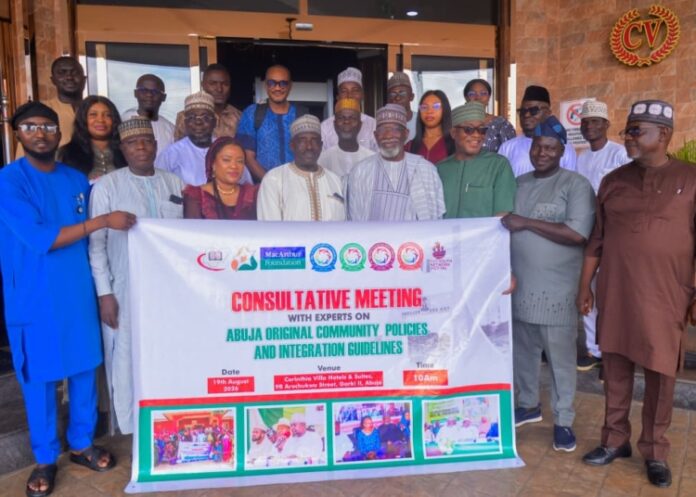
Abuja’s Original Inhabitants have renewed their call for greater participation in the planning, governance and economic development of the Federal Capital Territory (FCT), urging authorities to formally integrate their communities into the Abuja Master Plan.
The demand was made in Abuja during a consultative meeting on the Abuja Original Inhabitants Community Development Policy and Integration Framework. The gathering attracted community leaders, youth representatives, civil society organisations, experts and other stakeholders.
The consultation was supported by the MacArthur Foundation through the Centre for Human Rights and Civic Education (CHRICED), working with the FCT Stakeholders Assembly and SIMBA Interlinks Ltd.
Discussions centred on the proposed policy and integration guidelines, which are intended to address the concerns of Original Inhabitant communities and strengthen their participation in the social, economic and political development of the FCT.
Executive director of the Abuja Original Inhabitants Youths Empowerment Organisation (AOIYEO), Commandant Isaac David, said the consultation provided an opportunity for stakeholders to critically assess the policy document and establish a shared position around the interests of Original Inhabitants.
According to David, experts prepared the document as a foundation for developing a common position and engaging the government at various levels.
He explained that the framework would also guide the preparation of the Original Inhabitants’ charter of demands ahead of the 2027 elections.
Political candidates seeking residents’ support would be presented with the communities’ demands, he said, adding that the document could later provide a basis for legislative proposals by the next FCT senator and members of the House of Representatives.
“What we intend to do with this document is to prepare ahead of 2027. Before the election, there will be campaigns by Mr President, the Senate and House of Representatives, and this will be part of our charter of demands,” he said.
David also said the group intended to seek an opportunity to present the framework to the Minister of the FCT, Nyesom Wike, for consideration by the FCT Administration.
He emphasised that unity among the Original Inhabitant communities would be essential to achieving their shared objectives.
President of the FCT Stakeholders Assembly, Dr Aliyu Daniel Baka, described the consultation as an important platform for stakeholders to contribute to the development and review of policies affecting communities in Abuja.
Baka maintained that Original Inhabitants should be properly integrated into the Abuja Master Plan, particularly given the government’s adoption of integration as a policy direction.
He recalled that 58 communities were located in the area before the creation of the FCT, noting that policies concerning their status and integration had evolved over time.
He said the ongoing review of the Abuja Master Plan presented an opportunity to address existing gaps and ensure that Original Inhabitant settlements were recognised in the planning and development of the territory.
“The federal government has accepted the policy of integration. We believe that in the planning process, our communities and settlements will be integrated into the Abuja Master Plan. That is basically integration,” Baka said.
He added that integration should extend beyond physical planning to include economic opportunities, arguing that Original Inhabitants should benefit from the economic activities and opportunities created by Abuja’s development.
Baka also advocated political inclusion, describing Original Inhabitants as among the most marginalised groups and expressing optimism that the Master Plan review would tackle the challenges they face.
However, he clarified that membership of the FCT Stakeholders Assembly was not limited to Original Inhabitants, stressing that long-term residents and people born in the territory were also important stakeholders.
“FCT stakeholders are simply not only for Original Inhabitants. It is also for residents and others who are stakeholders,” he said.
Baka pointed out that millions of Nigerians had established permanent homes in Abuja and should consequently be involved in conversations about the territory’s future.
He disclosed that the Assembly had already prepared a charter of demands but said the document remained open to additional concerns and recommendations arising from the consultation.
“This input we are putting together is going to constitute part of our charter of demands that we will send to government,” he said.
Baka also praised President Bola Ahmed Tinubu for the infrastructure being provided across the FCT, urging residents to recognise the administration’s efforts.
He said the infrastructure projects formed part of government’s efforts to integrate communities and improve the territory.
“Mr President has done well for us, and 2027 is an opportunity for us to come out en masse and say thank you,” he said.
Stakeholders at the meeting stressed the importance of maintaining dialogue between government and communities, insisting that policies affecting Original Inhabitants should be developed with their participation.
They also called for stronger representation, improved infrastructure, economic empowerment, protection of community interests and increased participation in decision-making.
The consultation concluded with stakeholders reaffirming their commitment to working collectively on an inclusive framework that would give Abuja’s Original Inhabitants, as well as other residents, a stronger voice in the future development of the FCT.
Source: Leadership
Do you want to share your impact stories or pitch the coverage of your CSR event to us? E-mail: editor@impactwatch.net or *Phone +234-806-795-0250 (Whatsapp &Text)


