

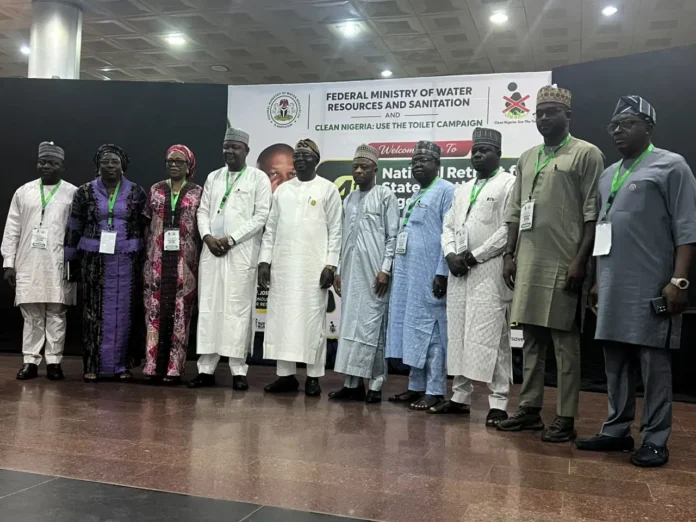
The Minister of Water Resources and Sanitation, Joseph Utsev, appealed on Tuesday in Abuja while delivering the keynote address at the National Retreat on the Clean Nigeria: Use The Toilet Campaign.
Utsev emphasised that access to safe and dignified sanitation is essential to protecting public health, preserving human dignity, promoting environmental sustainability and supporting national development. He maintained that eliminating open defecation would require coordinated efforts beyond government-led interventions.
He said the Clean Nigeria Campaign supports President Bola Tinubu’s Renewed Hope Agenda, which focuses on improving citizens’ welfare, strengthening public institutions and promoting inclusive development.
Providing an update on the campaign, the minister disclosed that 185 of Nigeria’s 774 local government areas had achieved Open Defecation Free (ODF) status since the initiative began in November 2019.
Although the figure remains below the anticipated target of approximately 300 local governments, Utsev expressed confidence that the number could increase to 400 by next year if interventions were accelerated and stakeholders strengthened their commitment.
He attributed the progress achieved so far to political will, effective coordination, adequate support and active community participation.
However, he cautioned against slowing down efforts, urging stakeholders to intensify interventions in communities yet to attain ODF status while ensuring that areas already certified maintain their sanitation standards and do not return to open defecation.
The minister also revealed that President Tinubu had recently signed an Executive Order on Open Defecation Free Nigeria by 2030 and Other Related Matters, reinforcing the government’s commitment to ending the practice.
According to Utsev, Vice President Kashim Shettima is expected to formally unveil the Executive Order on November 19, 2026, during the World Toilet Day celebration and the seventh anniversary of the Clean Nigeria Campaign.
In his welcome address, the Acting Permanent Secretary of the Ministry, Ali Dallah, described the national retreat as an opportunity to improve institutional cooperation, identify obstacles to implementation and develop lasting solutions for achieving universal access to safe sanitation.
Dallah explained that eliminating open defecation would depend on consistent funding, dependable data management systems, effective institutional structures, coordination across different levels of government and continuous public awareness.
He particularly highlighted the responsibilities of state and local governments, calling for stronger political commitment, increased budgetary provisions and the inclusion of sanitation objectives in government development plans.
He also challenged participants to ensure that the retreat produced measurable outcomes, including practical commitments, achievable acceleration programmes, sustainable funding arrangements and implementable strategies rather than relying solely on declarations and ODF certifications.
Representing state governments, the Benue State Commissioner for Water Resources, Sanitation and Climate Change, Udo Ogwu, reaffirmed their commitment to the national campaign.
Ogwu noted that while the Federal Government provides policy guidance and coordinates activities nationally, state governments are responsible for converting those policies into interventions within communities, schools, markets, motor parks and healthcare facilities.
He said states were reviewing and strengthening their policies while providing the political backing needed to advance the campaign.
He added that the retreat would enable participating states to share experiences, evaluate their performance and identify approaches capable of delivering sustainable sanitation improvements.
Similarly, the Country Director of Self Help Africa, Joy Aderele, described the gathering as an important opportunity to build on Nigeria’s existing sanitation achievements and increase the pace of progress towards the 2030 objective.
She acknowledged the milestones recorded through the Clean Nigeria Campaign but stressed that maintaining progress would require sustained commitment, better monitoring systems and stronger institutional accountability to prevent communities from reversing their achievements.
UNICEF’s WASH Manager, Jolly Ann Maulit, observed that the campaign had developed beyond a nationwide awareness programme into an initiative promoting behavioural change and better sanitation habits across communities.
She highlighted the progress made by Jigawa State, which became Nigeria’s first Open Defecation Free state in 2022, followed by Katsina State in 2025. She also noted that additional local governments were advancing towards ODF certification.
Despite these developments, Maulit revealed that approximately 48 million Nigerians still practise open defecation, demonstrating the significant work remaining.
She outlined four priority areas for accelerating progress. These include improving the reliability of performance data to identify communities requiring urgent attention; protecting existing ODF achievements through proper toilet usage, maintenance and repairs; incorporating sanitation objectives into state policies, budgets and institutional arrangements; and obtaining firm government commitments backed by accelerated implementation plans.
Maulit stressed that securing ODF certification should not mark the end of the process, explaining that communities must sustain proper sanitation habits to avoid returning to open defecation.
She also reaffirmed UNICEF’s readiness to continue assisting state and local governments in strengthening sanitation systems and achieving the 2030 national target.
A representative of the World Health Organisation (WHO) also drew attention to the health consequences of inadequate sanitation, disclosing that approximately 23 per cent of Nigeria’s population, equivalent to about 48 million people, still engage in open defecation.
He warned that communities where the practice remains common face increased exposure to cholera and other diseases associated with poor sanitation.
The WHO representative called for a transition from occasional environmental cleanliness campaigns to continuous behavioural change, urging Nigerians to make hygiene and sanitation regular aspects of their daily activities.
He also identified a significant difference between public awareness and actual handwashing habits. According to him, although many Nigerians understand the importance of hand hygiene, only about four per cent practise it daily.
He recommended incorporating hand hygiene more prominently into the Clean Nigeria Campaign and strengthening cooperation among the Ministries of Water Resources and Sanitation, Environment and Health.
On funding requirements, the WHO representative estimated that approximately N4 trillion would be needed to achieve the campaign’s objectives by 2030.
He emphasised the importance of developing sustainable financing arrangements and increasing investment in sanitation, describing the sector as both a public health priority and an important contributor to environmental protection and economic development.
The National Retreat brought together government officials, development partners, civil society organisations and private-sector representatives to assess the progress of the Clean Nigeria Campaign.
Participants also examined institutional and financial challenges and explored strategies for accelerating the country’s transition towards eliminating open defecation by 2030.
SOURCE:Vanguard
Do you want to share your impact stories or pitch the coverage of your CSR event to us? E-mail: editor@impactwatch.net or *Phone +234-806-795-0250 (Whatsapp &Text)


