

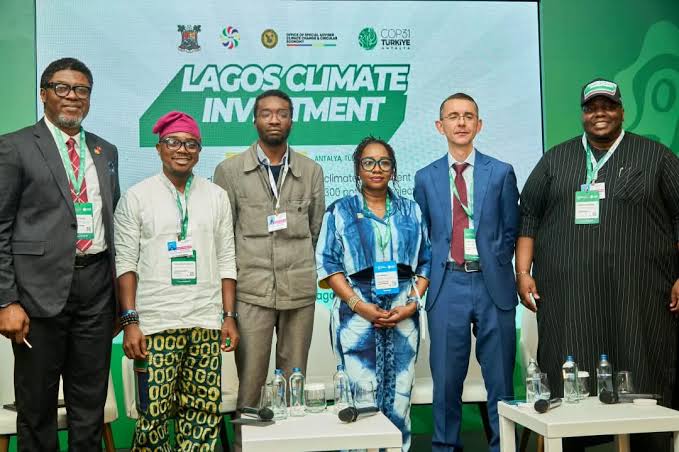
The investment discussions took place during the 31st United Nations Climate Change Conference (COP31) in Antalya, Türkiye, where the state government showcased more than 300 potential climate-related projects to international investors and private-sector partners.
The initiative seeks to mobilise private investment, encourage sustainable business development and transform proposed climate projects into commercially viable ventures capable of generating employment and supporting economic growth.
Participants included financial institutions, energy companies, project developers, private investors and emerging businesses already operating within the green economy. The engagements featured project presentations, investment pitches, business networking and discussions on possible financing and partnership arrangements.
Opportunities explored covered healthcare, solar energy, women’s empowerment and clean transportation, with some investors expressing interest in supporting specific projects.
Speaking at the Lagos Climate Investment Day reception, which marked the conclusion of the state’s week-long investor engagements, the Special Adviser to the Governor on Climate Change and Circular Economy, Titilayo Oshodi, said the discussions had reinforced the government’s confidence in attracting private-sector financing for climate initiatives.
Oshodi explained that the engagements connected government institutions, private businesses, emerging green enterprises and financial institutions to examine how available funding could support sustainable projects.
She also emphasised the government’s intention to move beyond investment announcements and ensure that proposed partnerships translate into implemented projects, employment opportunities and economic benefits for Lagos residents.
The investment pipeline presents potential opportunities for micro, small and medium-sized enterprises (MSMEs) operating in climate-related and environmentally sustainable sectors.
Businesses involved in solar installations, renewable energy distribution, waste recycling, clean transportation, healthcare services and sustainable production could potentially participate in projects developed through the initiative.
For renewable energy enterprises, growing investor interest could create demand for solar equipment, installation services, maintenance and other energy solutions.
Similarly, waste management and recycling businesses could benefit from partnerships that provide access to resources and markets for transforming discarded materials into commercially valuable products.
The government’s engagement with emerging green enterprises also creates potential opportunities for startups and small businesses developing solutions in environmental protection, clean energy and resource management.
However, the discussions remain at the initial partnership stage. The Lagos State Government has not announced a general funding application, grant scheme or dedicated financing programme for MSMEs under the investment pipeline.
One of the private-sector partners involved in the initiative, Tonye Cole, said the platform was established to connect international investment capital with sustainable development projects and businesses across Africa.
Cole explained that he and his partner, Funke Shobanjo, had developed a platform designed to link available global funding with projects and businesses requiring financing at the grassroots level.
He added that the collaboration with the Lagos State Government would create an opportunity to bring businesses, government institutions and investors together to develop sustainable projects.
The Chief Operating Officer of FBNQuest Merchant Bank, Funke Shobanjo, also expressed support for the initiative, noting that private investors were prepared to provide financing through a pan-African sustainable finance platform.
According to her, the platform would support climate-related projects under Lagos State’s investment agenda.
The discussions have also generated interest in projects addressing social development challenges.
A member of the Lagos delegation disclosed that five investors had indicated their willingness to partner on projects, including healthcare insurance initiatives aimed at reducing out-of-pocket medical expenses.
Sterling Bank also indicated its readiness to support women’s empowerment programmes in Lagos by providing between 50 and 100 tricycles.
In another proposed partnership, Worldwide Energy pledged to solarise a primary healthcare centre.
These potential collaborations highlight the broad scope of Lagos State’s climate investment agenda, which extends beyond conventional renewable energy initiatives to include improved healthcare access and economic empowerment.
Climate and carbon asset expert, Dr Adebola Odunsi, also highlighted the economic opportunities that could emerge from partnerships involving different states and business sectors.
He explained that waste generated in one state could serve as raw material for businesses in another, creating opportunities for commercial transactions, investment and shared environmental benefits.
This approach could benefit MSMEs engaged in waste collection, recycling, material recovery and the manufacturing of products from recycled materials.
Businesses operating within the circular economy could explore partnerships to supply raw materials, establish processing facilities and connect with larger companies seeking sustainable production solutions.
For small businesses, access to investment, technical partnerships and expanded markets could provide opportunities for business growth and increased participation in the green economy.
Lagos State’s climate investment pipeline, estimated at between $25 billion and $50 billion, is designed to attract private-sector financing for more than 300 potential projects.
Despite the initial expressions of interest from investors, the government has yet to confirm the complete list of successful partnerships, specific funding amounts or project implementation timelines.
MSMEs seeking to benefit from the initiative are encouraged to monitor announcements from the Lagos State Government, particularly the Office of the Special Adviser on Climate Change and Circular Economy, for updates on project development, partnership opportunities and potential business participation.
Businesses operating in renewable energy, waste management, recycling, clean transportation, healthcare and other green economy sectors should also prepare their business profiles, project proposals and service information as further investment opportunities develop.
SOURCE:MSME Africa Online
Do you want to share your impact stories or pitch the coverage of your CSR event to us? E-mail: editor@impactwatch.net or *Phone +234-806-795-0250 (Whatsapp &Text)


