

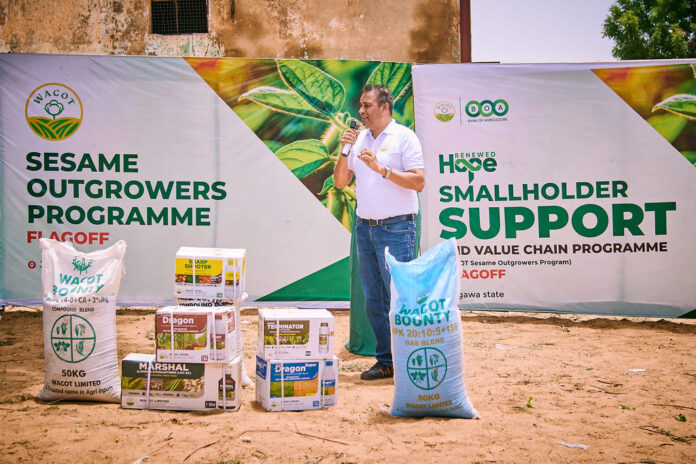
WACOT Limited, in partnership with the Bank of Agriculture (BOA), has launched its 2026 Sesame Outgrower Programme in Jigawa State, with more than 10,000 smallholder farmers set to benefit from financing, quality agricultural inputs, extension support and improved farming practices.
The initiative is being implemented under the Federal Government’s Renewed Hope Smallholder Support and Value Chain Programme.
The 2026 programme commenced with the distribution of agricultural inputs to farmers in Medu Village, Gagarawa Local Government Area of Jigawa State.
Under the arrangement, participating farmers will access input loans and repay the loans with farm produce after harvesting. Extension services will also be provided to support higher productivity, improve crop quality and promote the long-term sustainability of farming activities.
The WACOT-BOA partnership extends beyond sesame production in Jigawa, with similar interventions supporting rice farmers in Kebbi State and maize and soybean farmers in Katsina State.
Speaking at the launch, WACOT Limited Managing Director, Naveen Chaurasia, said the company remained focused on maintaining international quality standards while ensuring farmers benefit from the agricultural value chain.
“When farmers succeed, everyone benefits,” Chaurasia said, stressing that stronger livelihoods for farmers would contribute to the development of the wider agricultural ecosystem.
The Head of Corporate Responsibility and Sustainability at TGI Group, Yosola Onanuga, said WACOT had maintained investments in farmers’ capacity through training, extension services and sustainable agricultural practices.
She described the collaboration with BOA as another milestone that would give farmers access to subsidised input loans backed by a structured repayment arrangement.
Representing the BOA Managing Director, Ayo Sotinrin, the bank’s Executive Director, Operations, Tosin Salami, described the partnership as an example of how collaboration between financial institutions and private-sector operators could create sustainable value throughout Nigeria’s agricultural sector.
A beneficiary farmer, Laure Haladu, said WACOT’s intervention had contributed to improved farming practices and higher yields.
She also noted that additional skills provided through the initiative, including soap and briquette making, had created further income-generating opportunities for women.
According to WACOT, the programme was established in 2018 as a pilot scheme and has grown into one of Nigeria’s major contract farming programmes.
The company said the initiative now covers more than 10,000 farmers across eight local government areas in Jigawa State.
WACOT said it had disbursed more than ₦1 billion in input credit over the past seven years through the programme.
The financing has enabled farmers to access certified seeds, fertilisers and crop protection products, alongside technical assistance delivered through the company’s Farmers Academy and extension services.
The programme also prioritises greater participation by women and young people, while encouraging climate-smart and sustainable agricultural practices.
The launch brought together government officials, traditional leaders, development partners, farmers and other stakeholders.
Activities at the event included the distribution of agricultural inputs, agronomic demonstrations, financial literacy sessions and testimonials from participating farmers.
WACOT said the programme would continue to improve farmers’ access to productive inputs, financing and markets while supporting higher yields and sustainable livelihoods across Nigeria’s agricultural value chain.
Source: MSME Africa Online
Do you want to share your impact stories or pitch the coverage of your CSR event to us? E-mail: editor@impactwatch.net or *Phone +234-806-795-0250 (Whatsapp &Text)


