

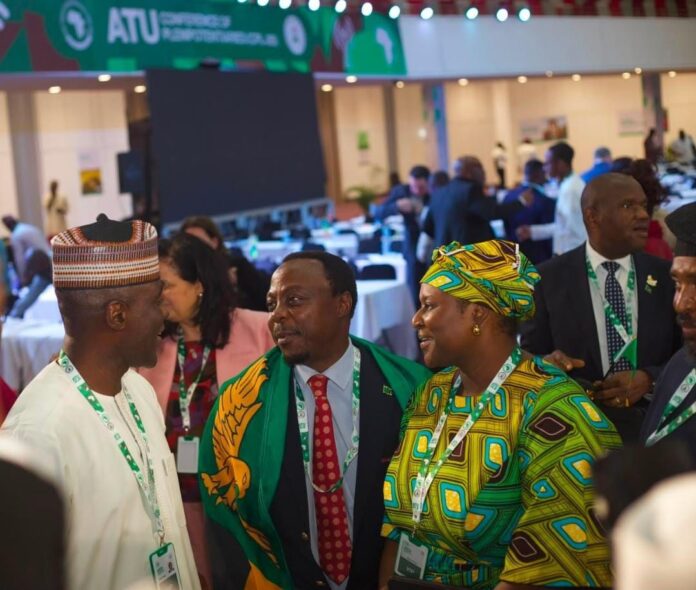
The Nigerian Communications Commission (NCC) has called on telecommunications regulators across Africa to deepen collaboration and embrace evidence-based governance as the continent adapts to the fast-changing landscape of artificial intelligence (AI), satellite communications and digital public infrastructure.
The appeal was made by the Executive Vice Chairman and Chief Executive Officer of the NCC, Dr. Aminu Maida, during the Heads of Regulators Roundtable held as part of the African Telecommunications Union (ATU) gathering in Abuja.
Addressing participants during the session themed “Building Africa’s Network Intelligence Ecosystem for Evidence-Based Regulation,” Maida stressed that individual national regulatory approaches are no longer adequate to support the growth of Africa’s digital economy.
According to him, although regulators operate under different legal systems and market environments, they continue to face similar challenges, including infrastructure gaps, cybersecurity risks, satellite integration and AI governance.
“Very often, the challenge one regulator is trying to solve has already been encountered, in one form or another, by a colleague elsewhere on the continent,” Maida stated. “The question before us is how we make the exchange of experience more deliberate, systematic, and actionable for all our institutions.”
He added that regulatory decisions should increasingly be informed by strong market intelligence, real-time analytics and cross-border data sharing to protect investments while improving Quality of Experience (QoE) for consumers across Africa.
Legacy telecom regulations no longer sufficient
Supporting the NCC chief’s position, the Commission’s Executive Commissioner for Stakeholder Management and Chair of the Roundtable, Ms. Rimini Makama, said regulatory systems originally designed for voice-focused telecommunications can no longer address today’s rapidly evolving digital environment.
Makama explained that while regulators across Africa now gather extensive technical, compliance and consumer data, the greater challenge is converting that information into proactive regulatory action.
“The old regulatory approaches were built for a simpler time. They are no longer enough,” Makama emphasized. “Our markets are no longer simple. Broadband is expanding rapidly, satellite services are arriving at scale, and AI, cloud computing, and digital public infrastructure are reshaping our entire economic fabric. To stay ahead, regulators must transition from reactive oversight to data-driven regulatory intelligence.”
She also highlighted Nigeria’s integrated regulatory intelligence platform, which consolidates consumer feedback, compliance analytics, Quality of Service (QoS) and Quality of Experience (QoE) indicators into a unified operational system that supports regulatory decision-making.
RASCOM commends Nigeria’s digital monitoring system
The Director-General of the Regional Africa Satellite Communications Organisation (RASCOM), Timothy Ashong, praised Nigeria’s leadership in deploying data-driven regulatory tools.
Ashong pointed to the country’s infrastructure monitoring technology, which enables regulators, telecom operators and consumers to monitor fibre cuts and network disruptions in real time. He encouraged other African nations to adopt similar systems.
He also urged governments across the continent to strengthen network resilience and reduce the digital divide by investing simultaneously in terrestrial fibre-optic infrastructure and satellite communications.
Why Africa is moving toward harmonised telecom regulation
The call for stronger regional regulatory cooperation comes as Africa’s telecommunications sector undergoes significant transformation.
For many years, telecom regulation across the continent largely focused on national priorities such as voice licensing, spectrum allocation and basic service standards within individual countries.
However, several developments are reshaping that model.
The rapid adoption of frontier technologies—including generative AI, multi-cloud computing and Next-Generation Satellite Constellations, such as Low Earth Orbit (LEO) satellites—has introduced complex cross-border issues involving data governance, spectrum interference and consumer privacy.
At the same time, repeated disruptions to subsea cables and terrestrial fibre networks have exposed shared infrastructure vulnerabilities. Coordinated, real-time intelligence systems can help neighbouring countries reroute traffic and maintain network availability across borders.
Through the African Telecommunications Union (ATU), member states are also working toward harmonised regulatory positions that will strengthen Africa’s voice at international organisations such as the International Telecommunication Union (ITU), allowing the continent to play a greater role in shaping global telecommunications standards.
By hosting the Heads of Regulators Roundtable in Abuja, the NCC further reinforces Nigeria’s role as a leading hub for digital policy innovation while advancing efforts to build a unified, data-driven digital economy across Africa.
Source: Star Connect Media
Do you want to share your impact stories or pitch the coverage of your CSR event to us? E-mail: editor@impactwatch.net or *Phone +234-806-795-0250 (Whatsapp &Text)


