

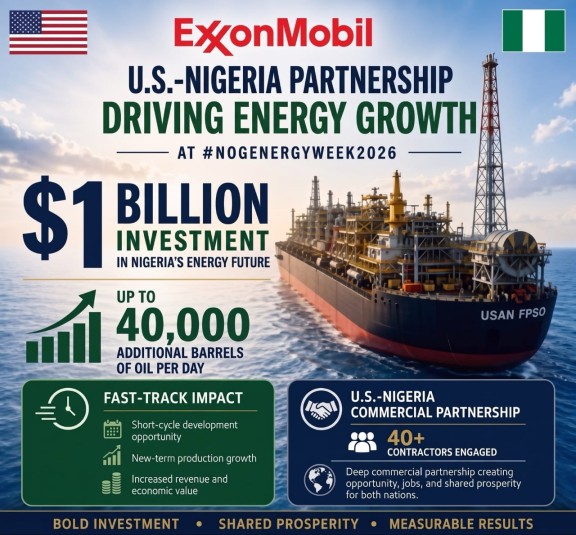
ExxonMobil and its international joint-venture partners have committed $1 billion to a new deepwater development designed to raise Nigeria’s crude oil production by up to 40,000 barrels per day, marking one of the company’s most significant investments in the country’s offshore sector in nearly a decade.
The announcement was made during the 25th NOG Energy Week conference in Abuja, where the energy giant confirmed plans to launch its first major offshore drilling campaign in Nigeria since 2016. The development comes as the country’s petroleum industry continues efforts to recover from years of pipeline vandalism, operational challenges, and reduced investment.
At the center of the initiative is the Usan Infill Project, which will be executed at the offshore Usan field in Oil Mining Lease (OML) 138, located approximately 60 miles off the Niger Delta coastline.
The project will be undertaken by Esso Exploration and Production Nigeria Offshore East Limited, an ExxonMobil affiliate, under a Production Sharing Contract (PSC) with NNPC Limited. International energy companies Chevron, TotalEnergies, and Nexen, a subsidiary of CNOOC, are also participating in the venture.
Speaking on the investment, Jagir Baxi, Chairman, Managing Director, and Lead Country Manager for ExxonMobil affiliates in Nigeria, said:
“This is what U.S.-Nigeria partnership delivers: bold investment, shared prosperity, and measurable results that strengthen our nations’ economic ties for years to come,”
Unlike traditional greenfield oil developments that often require several years before production begins, the Usan Infill Project has been structured as a fast-track, short-cycle development.
The project leverages advanced 3D seismic acquisition and subsea processing technologies, with completion in 2024. Engineers intend to connect newly drilled infill wells directly to the existing floating production, storage, and offloading (FPSO) facility already operating within OML 138.
According to project plans, initial production is expected to begin within six months of execution, with output projected to reach a peak of 40,000 barrels per day within 18 months.
The development will also rely on an extensive international supply chain. More than 40 primary contractors are expected to participate in subsea equipment installation and engineering activities, including six major U.S.-based oilfield service companies with longstanding operations in Nigeria, underscoring continued American involvement in the modernization of West Africa’s offshore energy assets.
Regulatory reforms drive renewed investor confidence
The investment comes at a critical period for Nigeria, a member of the Organization of the Petroleum Exporting Countries (OPEC), which has struggled to consistently meet its production quotas over the past five years.
Nigeria’s oil production, once close to 2.2 million barrels per day, declined to periods below 1.2 million barrels per day in recent years. Industry setbacks were largely attributed to oil theft, pipeline vandalism, and tensions within host communities across the Niger Delta.
Those challenges prompted several international oil companies, including Shell, TotalEnergies, and ExxonMobil, to reassess their Nigerian portfolios by divesting onshore assets to indigenous operators while directing new investments toward offshore deepwater fields that are less exposed to security risks.
In response, the Federal Government introduced the Petroleum Industry Act (PIA) alongside executive orders to simplify project approvals, reform fiscal policies, and provide incentives for deepwater operators to attract fresh foreign investment.
The Nigerian Upstream Petroleum Regulatory Commission (NUPRC) described the Usan project as evidence that those reforms are beginning to yield results.
Commission Chief Executive Oritsemyiwa Eyesan said the 2022 renewal of OML 138’s lease for an additional 20 years created the conditions necessary for ExxonMobil’s return to offshore drilling.
“The investment is particularly noteworthy because it marks ExxonMobil’s return to active drilling operations in Nigeria after nearly a decade,”
Eyesan added that the Commission estimates the infill project will generate approximately $1.2 billion in additional revenue for the Federal Government over the next four years.
Since commercial production began at the Usan field 14 years ago, ExxonMobil and its joint-venture partners have invested more than $16 billion in OML 138. The block has produced over 350 million barrels of crude oil while contributing approximately $4.6 billion in direct fiscal value to Nigeria.
Beyond its domestic significance, the Usan Infill Project also highlights the growing importance of short-cycle infill drilling as a strategy for increasing global oil supply without the higher capital requirements associated with entirely new greenfield developments.
For Nigeria, the investment represents another step toward strengthening crude oil production, improving government revenues, and reinforcing its position as West Africa’s leading energy exporter.
Source: Star Connect Media
Do you want to share your impact stories or pitch the coverage of your CSR event to us? E-mail: editor@impactwatch.net or *Phone +234-806-795-0250 (Whatsapp &Text)


