

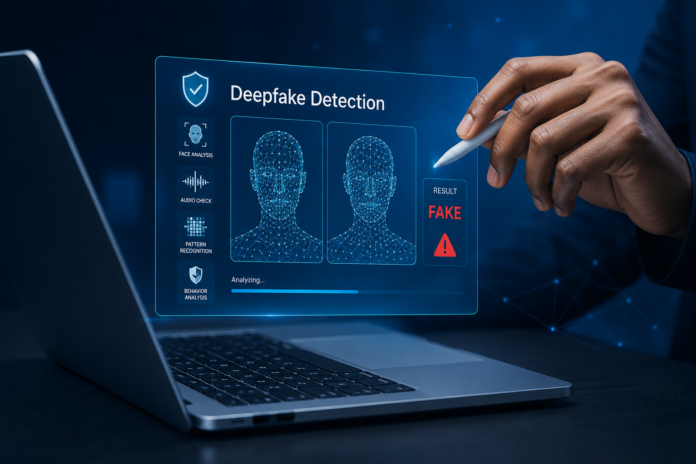
£Artificial Intelligence (AI) is rapidly transforming industries, government services and everyday interactions, but experts say the same technology is also driving a new generation of cybercrime marked by increasingly convincing digital deception.
The era when photographs and videos were widely accepted as unquestionable proof is fading as AI-generated deepfakes, cloned voices, manipulated images and fabricated digital content become sophisticated enough to challenge investigators, journalists, businesses and even the judicial system.
Unlike conventional cybercrime, which largely depended on phishing attacks, stolen passwords and malware, generative AI now enables criminals to create realistic fake identities, forged documents, fabricated audio recordings and convincing videos within minutes. The result is that complex fraud schemes have become faster to execute and more accessible than ever before.
The growing threat is reflected in global cybersecurity assessments. According to the World Economic Forum’s Global Cybersecurity Outlook 2025, 66 percent of organisations believe AI will have the greatest impact on cybersecurity this year, while 47 percent identify AI-powered attacks as their primary concern.
Similarly, the FBI’s Internet Crime Complaint Center (IC3) reported internet crime losses exceeding $16 billion in 2025, driven by increasing use of AI-powered phishing campaigns, voice cloning and identity fraud.
Nigeria is also facing similar risks. As digital banking platforms and online services continue to expand, reports from the Nigeria Inter-Bank Settlement System (NIBSS) and the Nigeria Cybersecurity Outlook 2025 indicate that identity theft, account takeover, AI-generated phishing attacks and deepfake scams are becoming increasingly sophisticated.
Research conducted by Sumsub further revealed that global deepfake fraud increased by more than 200 percent between 2023 and 2024, reinforcing concerns that digital evidence can no longer be accepted without verification.
These developments formed the backdrop for discussions at the 2026 Global Forensics Summit in Lagos, where forensic experts, legal professionals and policymakers examined strategies for strengthening Nigeria’s ability to combat AI-driven crime.
Lagos expands forensic technology to combat digital crime
Responding to the evolving threat landscape, the Lagos State Government reaffirmed its commitment to expanding the deployment of advanced forensic technologies to tackle cybercrime, identity theft, digital fraud and other technology-enabled offences.
Speaking during the 2026 Global Forensics Summit, organised by the International Academy of Forensics, Governor Babajide Sanwo-Olu said scientific and technological evidence has become indispensable for modern criminal investigations because traditional investigative methods alone are no longer adequate.
Represented by the pioneer Permanent Secretary of the Citizens’ Mediation Bureau (CMB), Mrs. Aderinsola Olanrewaju, the governor explained that many criminal prosecutions fail, not because investigators lack suspects or witnesses, but because scientific evidence capable of surviving judicial scrutiny is often unavailable.
“Every year, thousands of criminal cases in Nigeria are stalled, not for want of witnesses, not for want of suspects, but for want of evidence that can withstand scrutiny in the court of law. The gap between investigations and what prosecutors can successfully prove is a forensic gap. Closing that gap is precisely why this summit matters.”
The state also highlighted progress made through its ISO/IEC 17025-accredited laboratory, which has supported investigations involving homicide cases, sexual offences and the identification of human remains using scientific evidence.
Officials disclosed that the laboratory’s second development phase, focusing on toxicology and forensic chemistry, is currently underway to strengthen Lagos State’s capacity to analyse substances recovered from crime scenes.
AI has transformed misinformation into digital deception
Legal practitioner and forensic expert Oluwatomi Ajayi told participants at the summit that misinformation has moved beyond traditional fake news into an era dominated by AI-generated deception.
According to her, artificial intelligence now allows criminals to manipulate photographs, produce realistic videos, clone voices and fabricate digital conversations with remarkable accuracy.
“The days when people believed pictures and videos could never lie are over,” she said, noting that AI-generated content can damage reputations, manipulate public opinion, derail investigations and even influence judicial proceedings.
Ajayi explained that the growing sophistication of AI-generated content means judges, investigators and journalists can no longer rely solely on visual appearances when evaluating digital evidence.
Why traditional fact-checking is no longer enough
Ajayi argued that conventional fact-checking methods are no longer sufficient to counter AI-generated misinformation.
Instead, investigators increasingly depend on digital forensic technologies capable of examining metadata, tracing the origins of online content, identifying manipulated media and detecting deepfake material.
She added that even digital information many people assume has disappeared permanently can often be recovered.
“People often believe deleting chats or files permanently removes them. That is not always the case. Digital forensic technologies can recover information that becomes vital evidence during investigations,” she explained.
According to her, these forensic capabilities enable investigators to reconstruct criminal activities, establish timelines and identify suspects using digital traces left behind across communication platforms and electronic devices.
Deepfakes present growing risks to the justice system
Experts at the summit warned that one of the greatest dangers posed by artificial intelligence is the possibility of fabricated digital evidence being introduced into legal proceedings.
A manipulated video could falsely implicate an innocent individual, while a cloned voice recording could influence investigations before its authenticity is scientifically verified.
Ajayi stressed that courts must increasingly depend on scientifically validated forensic examinations instead of relying on visual impressions alone.
She noted that specialised forensic software can determine whether digital photographs, audio recordings and videos have been altered before they are accepted as evidence.
Law enforcement is also using AI to fight cybercrime
Although artificial intelligence has strengthened criminals’ capabilities, experts noted that the same technology is becoming one of law enforcement’s most valuable investigative tools.
Machine-learning systems can now identify irregularities in digital files that may escape human investigators.
These technologies examine facial movements, lighting inconsistencies, editing patterns, metadata and audio frequencies to determine whether digital content has been manipulated.
Integrated with modern cybersecurity systems, AI also helps investigators detect phishing campaigns, hacking attempts and digital fraud before substantial damage occurs.
Nigeria strengthens legal and forensic capabilities
Nigeria has introduced several legal and policy measures aimed at improving national cybersecurity, including the Cybercrimes Act and the National Cybersecurity Policy and Strategy.
Ajayi also highlighted ongoing efforts to improve national cybersecurity coordination while expanding the application of forensic technologies in criminal investigations.
For Lagos State, technological investments have been reinforced through legislative reforms.
Sanwo-Olu said amendments to the Administration of Criminal Justice Law have modernised the state’s criminal justice framework by encouraging greater reliance on scientific evidence during criminal proceedings.
The governor also reaffirmed Lagos State’s commitment to stronger collaboration with forensic professionals, security agencies and relevant institutions.
“The infrastructure we have built is a foundation, not a ceiling. Our ambition is a justice system where evidence speaks clearly, courts decide swiftly, and citizens, whether victims seeking justice or suspects entitled to fair hearing, can trust the integrity of the process.”
As artificial intelligence continues to evolve, experts believe forensic science will play an increasingly critical role in safeguarding the justice system.
For investigators, prosecutors, journalists and judges alike, visual evidence alone can no longer be regarded as sufficient proof.
Instead, images, voice recordings and digital documents may increasingly require scientific verification before they can be considered reliable.
In the age of AI, experts concluded, the future of justice will depend less on eyewitness accounts and more on forensic technologies capable of distinguishing authentic evidence from increasingly convincing digital deception.
Do you want to share your impact stories or pitch the coverage of your CSR event to us? E-mail: editor@impactwatch.net or *Phone +234-806-795-0250 (Whatsapp &Text)


