

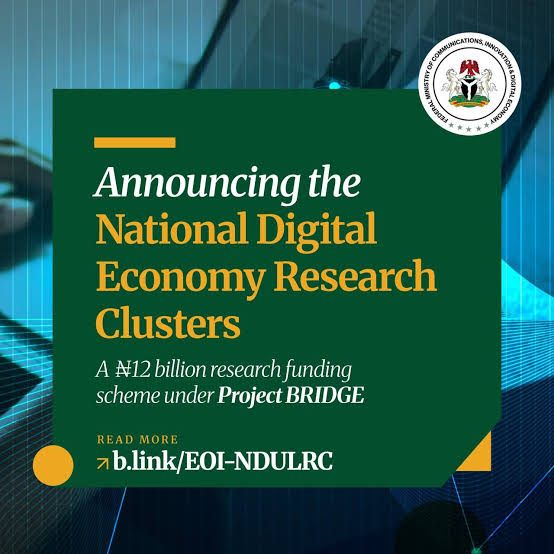
The Federal Government has said revealed plans to unveil a N12-billion Digital Economy Research Fund to support a national long-term digital transformation agenda.
The Minister of Communications, Innovations and Digital Economy, Dr. Bosun Tijani said, in a statement in Abuja, that the fund aims to strengthen evidence-based policymaking for the country’s digital economic outlook.
“Today, my heart is filled with deep joy as we announce the Expression of Interest for the National Digital Economy Research Clusters, a N12-billion research funding scheme designed to place ideas, evidence, and research at the centre of Nigeria’s digital transformation,” he said
The minister said the programme is being funded under Project BRIDGE, a federal initiative meant to deploy 90,000 kilometres of fibre optic backbone infrastructure across Nigeria to expand connectivity and enable a modern digital economy.
“This programme is being funded under Project BRIDGE, our initiative to deploy 90,000 kilometres of fibre optic backbone infrastructure across Nigeria to expand connectivity and enable a modern digital economy,” Tijani added.
He noted that as the government expanded digital infrastructure nationwide, research-backed approaches were required to ensure inclusive benefits.
“As we deepen our digital infrastructure coverage, thoughtful, evidence-based approaches are required to be deployed in society to ensure everyone benefits from this significant investment,” he said.
The minister noted that digital policy decisions are often shaped by market forces and political cycles rather than rigorous research and long-term thinking.
“Too often, the ideas shaping digital policy come predominantly from markets and political cycles rather than from research, evidence, and long-term thinking,” Tijani said.
According to him, under the initiative, six national research clusters will be established across key pillars of the digital economy, including connectivity and meaningful use; digital public infrastructure and government services; digital skills and human capital development; digital economy and jobs; online trust and consumer protection; as well as artificial intelligence and emerging technologies.
The minister said the clusters would be led by 36 professors drawn from Nigerian universities, working alongside international academic partners, with more than 200 researchers, including post-doctoral fellows and PhD candidates.
All these experts, the minister said, were expected to generate policy-relevant research.
“For me, the goal goes beyond research output. We are looking for better policies that lead to stronger institutions and a more prosperous society,” Tijani said.
He described the initiative as one of the ministry’s most meaningful programmes, stressing that it was intended to produce ideas that would outlast any single administration.
Do you want to share your impact stories or pitch the coverage of your CSR event to us? E-mail: editor@impactwatch.net or *Phone +234-806-795-0250 (Whatsapp &Text)


