

With rising temperatures leading to demand for more air conditioners and other cooling equipment, a new UN report launched Tuesday at COP28 climate talks in Dubai lays out a pathway to cut emissions across the cooling sector worldwide.
Over 60 countries signed up to a so called ‘cooling pledge’ with commitments to reduce the climate impact of the cooling sector, that could also provide “universal access to life-saving cooling, take the pressure off energy grids and save trillions of dollars by 2050.”
The cost of keeping cool
The UN Environment Programme (UNEP) estimates that more than 1 billion people are at high risk from extreme heat due to a lack of cooling access – the vast majority living in in Africa and Asia.
Moreover, nearly one-third of the world’s population is exposed to deadly heat waves more than 20 days a year.
The cooling brings relief to people and is also essential for several other critical areas and services such as global food security and vaccine delivery through refrigeration.
But at the same time, conventional cooling, such as air conditioning, is a major driver of climate change, responsible for over seven per cent of global greenhouse gas emissions. If not managed properly, energy needs for space cooling will triple by 2050, together with associated emissions.
In short, the more we try to keep cool, the more we heat the planet. If current growth trends continue, cooling equipment represents 20 per cent of total electricity consumption today – and is expected to more than double by 2050.
Energy guzzlers
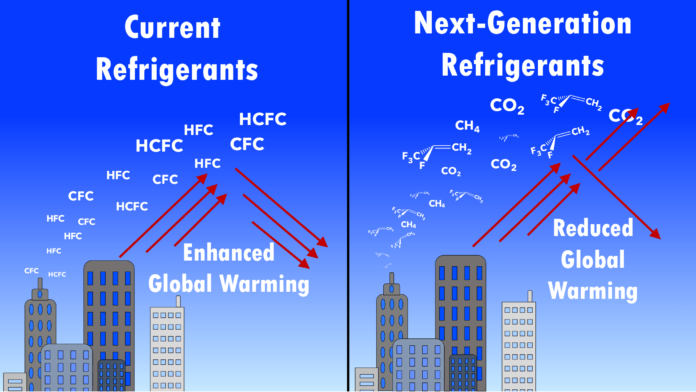
Today’s cooling systems, such as air-conditioners (ACs) and refrigerators, consume massive amount of energy and often use refrigerants that warm the planet.
The latest UNEP report shows that by taking measures to reduce the power consumption of cooling equipment could lead to a reduction of at least 60 per cent off predicted 2050 sectoral emissions by 2050.
“The cooling sector must grow to protect everyone from rising temperatures, maintain food quality and safety, keep vaccines stable and economies productive,” said Inger Andersen, Executive Director of UNEP, who launched the report during a press conference at Expo City, where COP28 has been underway since last Thursday.
“But this growth must not come at the cost of the energy transition and more intense climate impacts,” she urged.
Global Cooling pledge
The report was released in support of the ‘Global Cooling Pledge’, a joint initiative between the United Arab Emirates as host of COP28 and the UNEP-led ‘Cool Coalition’.
It outlines actions to take in passive cooling strategies — such as insulation, natural shading, ventilation and reflective surfaces, higher energy efficiency standards and a rapid phase down of climate-warming hydrofluorocarbon (HFC) refrigerants.
Following the report’s recommendations could reduce the projected 2050 emissions from business-as-usual cooling by around 3.8 billion tons of CO2equivalent.
This would:
Allow an additional 3.5 billion people to benefit from refrigerators, air conditioners or passive cooling by 2050: Reduce electricity bills for end users by US$1 trillion in 2050, and by US$17 trillion cumulatively between 2022 – 2050; Reduce peak power requirements by between 1.5 and 2 terawatts (TW) – almost double the EU’s total generation capacity today: and
Avoid power generation investments in the order of $4 to $5 trillion.
Published by HT Digital Content Services with permission from India Blooms.Provided by SyndiGate Media Inc. (Syndigate.info)
Do you want to share your impact stories or pitch the coverage of your CSR event to us? E-mail: editor@impactwatch.net or *Phone +234-806-795-0250 (Whatsapp &Text)


